Government Auction Car Inspection
Surplus and fleet vehicles fail in ways a private car never does. Thousands of idle hours that the odometer does not show, wiring cut when the equipment was stripped out, maintenance deferred to the next budget year, and rust underneath from a decade of salted roads. We inspect the lot before the clock runs out and tell you what it is really going to cost.
Ex-police, municipal and school district vehicles
Idle hours, stripped equipment and salt-belt rust are the findings that decide these lots. Every one of them is covered below.
Sites we cover
Government, surplus and online auction lots we inspect
If your lot is on one of the platforms below, send us the listing. Where the seller permits third-party access, we will arrange an inspection before the auction closes.
Government and municipal surplus
City, county, state and school district disposals. Mostly former fleet sedans, SUVs, pickups, utility trucks and buses.
GovDeals
The largest municipal surplus marketplace. City, county, state and school district lots.
Public Surplus
Municipal and school district surplus, particularly strong in the western states.
Municibid
City, county and municipal surplus auctions across the eastern and midwestern states.
GSA Auctions
Federal government surplus, from sedans and vans to trucks and heavy equipment.
GovPlanet
Military and government surplus vehicles, trailers and equipment.
State and county sales
Department sales run directly by a state agency, county or school district.
Police, sheriff and seized vehicle auctions
Department vehicles, seized and forfeited vehicles, and abandoned property sales. Usually the hardest lots to buy well.
Police and sheriff department sales
Retired patrol vehicles, admin cars and seized vehicles sold directly by the department.
PropertyRoom
Online auctions of seized and forfeited property for participating police agencies.
City and county seized vehicle sales
Abandoned and forfeited vehicles sold on behalf of a municipality.
Online auction platforms and auctioneers
Local auctioneers and regional platforms running municipal, business and school district disposals.
K-BID
Minnesota and upper-Midwest online auctions: businesses, municipalities and school districts.
HiBid
Platform used by local auctioneers across the country for municipal and estate vehicle lots.
Proxibid
Online bidding for auction houses running municipal, fleet and business disposals.
AuctionZip
Directory and online bidding for local auctioneers and government sales.
Fleet and heavy equipment disposal
Former municipal, DOT and utility equipment sold by the hour rather than the mile.
Purple Wave
Municipal, fleet and heavy equipment auctions, strong across the plains states.
IronPlanet
Heavy equipment, trucks and trailers from government and fleet disposals.
Ritchie Bros
Large-scale fleet and equipment unreserved auctions.
Bidadoo
Industrial and equipment auctions for government and corporate sellers.
TruckPlanet
Trucks, trailers and vocational vehicles from fleet and government sellers.
Access rules, buyer registration and whether an inspection is permitted at all vary by platform and by the individual sale. Some surplus lots sit on locked yards with appointment-only viewing. Send us the listing and we will confirm what can be arranged before you pay. RIZQ is not affiliated with any of the platforms listed above.
What fleet vehicles get wrong
The faults that decide a government auction lot
A retired fleet vehicle is not simply an old car. It was bought for a job, used hard for that job, and sold when the job was done. These are the ten things that go wrong, in the order they cost you money.
Idle hours that never appear on the odometer
Patrol cars, utility trucks and municipal sedans idle for hours every shift. A police interceptor showing 80,000 miles can carry 6,000 or more engine hours, which is engine and transmission wear closer to 200,000 miles. A mileage-only listing hides this completely, and there is no way to read it from the photos.
Stripped equipment and the holes it leaves
Light bars, radios, cages, partitions, gun racks, MDT mounts, antennae and decals are all removed before sale. What is left behind is drilled roofs and pillars, torn headliners, screw holes across the dashboard, adhesive residue and mismatched trim. Some of it is cosmetic. Some of it is a roof that now leaks.
Deferred maintenance from budget cycles
Fleet shops work to a budget, and when the money runs out, everything that is not a safety item gets pushed to the next cycle. Expect transmission fluid that has never been changed, coolant well past its interval, and brakes worn down further than a private owner would ever allow.
Electrical faults from cut upfit wiring
When aftermarket wiring is stripped out, harnesses are often cut rather than unplugged. That is genuinely expensive to put right: dead circuits, a battery that drains overnight, warning lights that will not clear, and faults that take hours of diagnosis to trace.
Interior wear far beyond the mileage
A patrol or utility vehicle is entered and left dozens of times a shift. Driver seat bolsters collapse, armrests crack, and the floor wears through long before the odometer would suggest. In a police vehicle the rear bench is often the worst surface in the car.
Salt-belt rust underneath
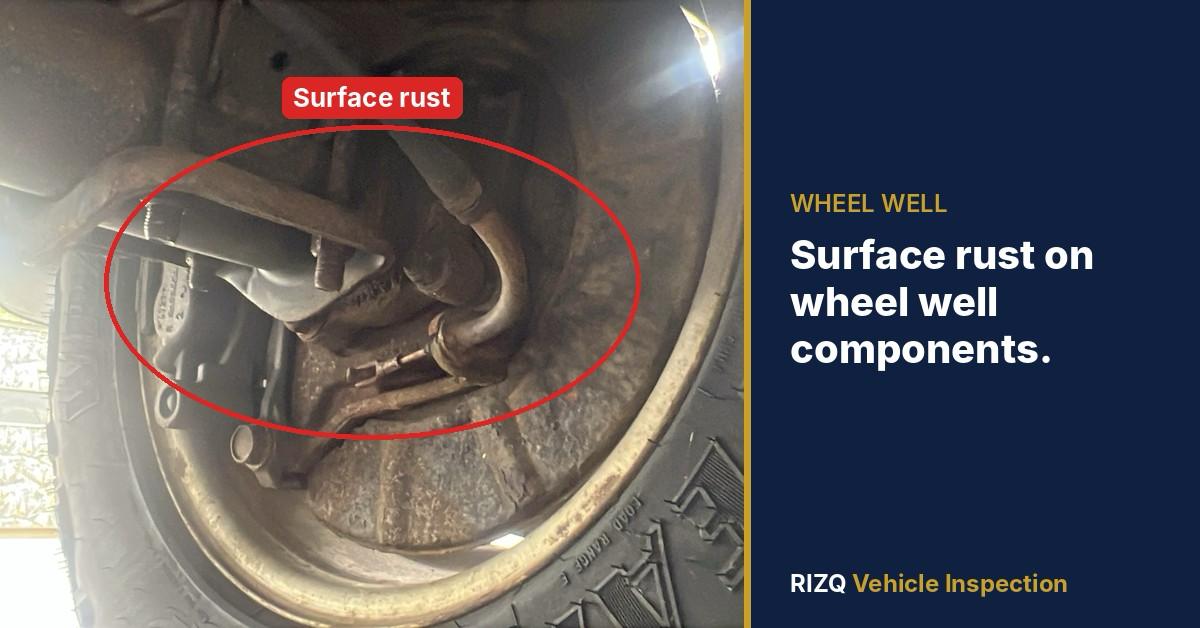
Municipal, DOT, school and plow fleets in the salt belt live on treated roads. Undercarriage rot, brake lines and subframe corrosion are the expensive findings, and they are invisible in every listing photograph because nobody photographs the underside.
Heavy equipment sold on hours, not miles
GSA, DOT and military surplus equipment is sold by the hour meter. The money items are hydraulic seepage, cracked and chafed hoses, worn pins and bushings, undercarriage wear and tyres that are perished rather than merely worn. Hydraulic repairs are where budgets disappear.
Long storage and a dead start
Surplus vehicles sit for months between decommissioning and sale. A vehicle parked for a year often needs a battery, brakes that have seized from sitting, stale fuel, and tyres flat-spotted where it stood. Whether it starts at all is the first thing worth knowing.
Repairs that no history report will ever show
Fleet vehicles are repaired in-house. Bodywork is done to a good-enough standard rather than an insurance-grade finish, and none of it reaches a history report. Panel gaps, paint texture and overspray are how you find it, which is exactly what a panel-by-panel inspection is for.
Fleet-only spec and hard-to-source parts
Interceptor brakes, heavy-duty cooling, deleted options and proprietary fleet equipment do not always cross-reference to the retail version of the same vehicle. Some of those parts are expensive, and some simply are not available any more.
What the inspection covers
The same on-site check on every auction vehicle, aimed squarely at the faults above.
How to book
Booked and inspected before the lot closes
Government and surplus auctions close on a fixed date and time, so the closing time is the deadline everything works back from. Here is how it runs from the moment you find the lot.
Send us the listing
Paste the auction URL and the lot number, name the site and the location, and tell us when bidding closes if you know. That closing time is the deadline we work to.
We confirm access
We check the platform, the yard and its rules, and tell you plainly whether an inspection can be arranged before the lot closes. If it cannot, we say so before you pay.
Book and pay
Payment locks in the inspection against the closing time. A same-day inspection can be added where an inspector is available.
The inspection happens
An inspector attends the lot and works through the fleet checks on this page, photographing as they go.
The report reaches you
Photographs, the RIZQ inspection score, and estimated repair cost ranges for everything found, with time left to raise, hold or walk away.
Government auctions usually close on a soft clock
Most government and surplus platforms use extended bidding. A bid placed in the final minutes resets the clock, so a lot can stay open for hours past its listed closing time. That cuts both ways: it can buy you extra time to read a report, but it also means the stated closing time is not a hard deadline you can plan around. Send the lot early and treat the listed close as your working deadline.
Why RIZQ
We inspect fleet disposals constantly
A surplus vehicle has its own failure patterns. An inspector who does not know them photographs the wrong things and writes a report that tells you nothing you could not see in the listing.
Fleet and surplus lots are routine work
Ex-police, municipal and school district vehicles have their own failure patterns, and an inspector who does not know them photographs the wrong things. We inspect fleet disposals constantly, so we know where to look.
We tell you when it cannot be done
Some surplus lots are on locked yards, some sales do not permit third-party inspection, and some close too soon. We would rather lose the booking than take your money for an inspection that cannot happen.
Written for a bidding decision
The report is built around the question you actually have: what is wrong with this vehicle, what will it cost to put right, and is the next bid still worth making.
The report
See a real RIZQ report before you book
These are genuine RIZQ reports, exactly as a customer receives them, covering one vehicle worth buying, one worth a closer look, and one to walk away from. The photographs, the inspection score and the estimated repair costs are all the same sections you get from an auction inspection.
See a real report before you book
Tap either report below to open it: one that passed, and one that did not.
Questions
Government auction inspection questions, answered
The things buyers ask us most before booking a surplus or fleet lot.
Start your auction inspection
Send us the lot you are bidding on
Paste the listing and tell us when bidding closes. It takes about a minute, then you go straight to secure checkout.
Auction inspection
$250 flat
Inspect the lot before it closes
Send us the listing and the closing time. We will tell you the same business day whether an inspection can be arranged in time.
Questions first? Call or text (952) 563-7444.