EV Pre-Purchase Inspection
A used electric car is not a used car with a battery in it. The things that cost real money are the pack underneath, the charging system, the drive units, the software and the driver assist hardware. A general inspection does not look at any of that. We inspect the car in front of the seller and put all of it in writing before you buy.
$219
EV Standard
$279
EV Complete
Charging
Plugged in and confirmed
24 hrs
Report turnaround
Used EV checklist
Ten things to check on a used electric car
Use this yourself before you buy anything. It is the same list our inspectors work from, and it will rule out most of the expensive mistakes in about half an hour on a forecourt.
Watch it charge, do not just look at the port
Ask the seller to plug the car in while you are standing there. A charge port that will not seat, or a car that starts and then stops charging, is the most expensive surprise on the used EV market and it takes two minutes to rule out.
Get underneath and look at the pack
The battery pack is the floor of the car. Scrapes, dents, swelling, corrosion or a missing underbody shield are all visible from ground level with a torch, and none of them appear in listing photographs.
Read the range the car reports, not the range in the advert
The car will tell you its own state of charge and estimated range. Compare that with what the listing claims. Energy consumption figures also show you how hard the car has actually been driven.
Check for warning codes on the screen
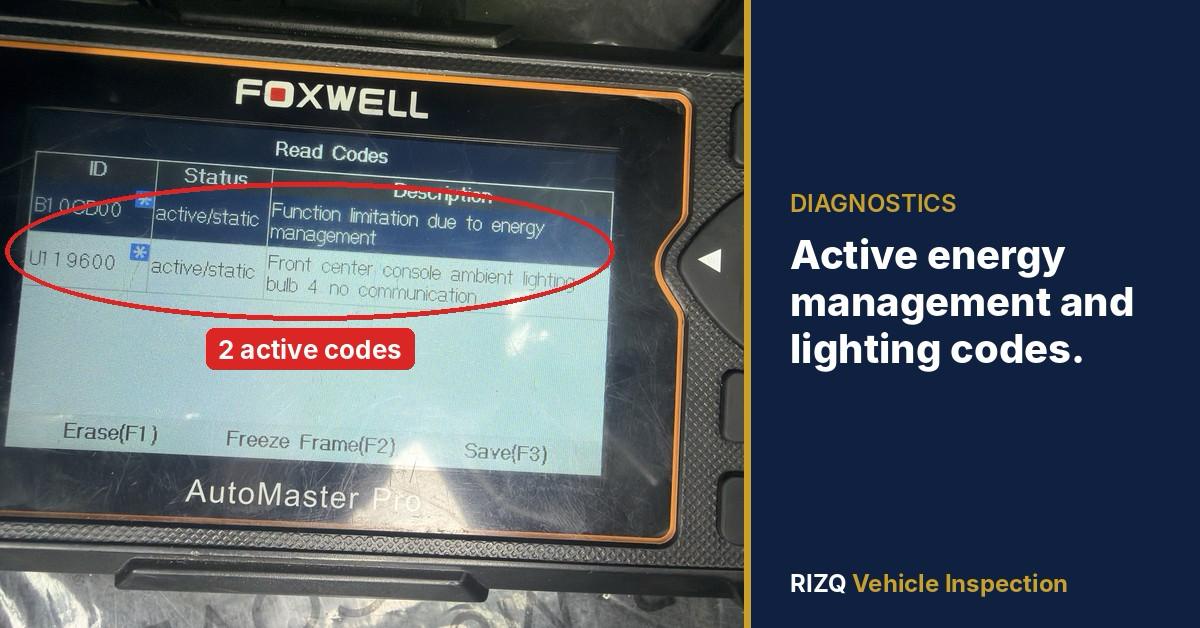
Sit in the car with it switched on and look at the display. Battery, drive system and energy management warnings are recorded on the car, and a seller clearing them before you arrive does not remove the underlying fault.
Find out which driver assist hardware the car has
On a Tesla this is HW3 or HW4, read from Controls, then Software, then Additional Vehicle Information. On other brands it is the driver assist package shown in settings. It changes what the car is worth and what it will support later.
Look hard at the brakes
Regenerative braking does most of the stopping on an EV, so the friction brakes do very little work and rust where they sit. Surface rust on rotors is normal, but seized calipers and heavily pitted rotors are not.
Check the tyres properly
EVs are heavy and produce instant torque, so tyres wear faster than on a petrol car of the same size. Measure tread depth on all four, look for uneven wear on the inner edges, and check the tyres match.
Test every control, not just the screen
Climate, windows, seats, cameras, sound, the frunk and the key or phone key. On an EV almost everything runs through electronics, and electronics are what fail on a car that has sat unused.
Check the 12V system
Every EV still has a conventional 12V battery running the computers and the locks. When it fails, the car can refuse to start entirely, and it is a cheap part that is often overlooked.
Drive it and listen
Steering pull, brake feel, regenerative braking, vibration and noises. With no engine noise to mask them, an EV is actually easier to hear problems in, so use that.
Everything on this list is what our inspectors check, plus the photographs and the written report. If you would rather not do it yourself on a stranger's forecourt, that is what we are for.
What we check
Ten checks, and every one of them photographed
An inspector attends the vehicle, works through the car in front of them, and photographs as they go. Nothing in the report was taken from the listing, and nothing was assumed.
Battery pack, photographed from the ground
The pack is photographed front, rear and both sides, looking for scrapes, dents, leaks, swelling, corrosion and damaged shields. Ground level only, no covers removed, no high voltage cables touched.
Charging test and charge port
The car is plugged in and confirmed to be charging, with the charge rate photographed on screen. The charge port, door and latch are inspected for damage.
Driver assist hardware and software
The driver assist package or computer is read from the vehicle and photographed, along with the software version and any over-the-air recalls outstanding on the car.
Warning codes and EV system alerts
Every fault and warning on the touchscreen and instrument cluster is photographed and written up, including battery, drive system and energy management alerts.
State of charge, range and energy use
The range and energy consumption the car itself reports are recorded, so you see how it has actually been used rather than how it is described.
Drive units and underbody
Front and rear drive units checked for leaks and damage, with the underbody shields, subframes and steering rack photographed as far as is reachable from the ground.
Tires, wheels and brakes
Tread depth measured in 32nds on every tyre, wheels checked for curb rash and bends, and pads and rotors photographed, including the rotor rust that regen braking causes.
Interior, controls and electronics
Seats, carpets, headliner and trim photographed and described, then the screen, climate, windows, seats, sound, cameras, frunk and key all tested and recorded.
Body, paint and prior repair
Every panel photographed and assessed, with panel gaps, paint mismatch, overspray, filler and sanding marks checked for signs of previous repair, plus glass, lights and mirror caps.
Road test
You drive it where the seller allows, on local roads and the highway. Steering pull, brake feel, regenerative braking, acceleration, vibration and noises are all recorded.
What our battery check does and does not do
We inspect the battery pack visually from the ground: the front, rear and both sides, photographed, looking for scrapes, dents, leaks, swelling, corrosion and damaged shields. We read the state of charge, range and energy use shown in the vehicle, and we record any active battery or EV system warning.
We do not test battery health, state of health or capacity, and we never plug in an external reader or open the pack. No honest inspection can promise you a battery percentage from a walkaround, so we do not. Any company quoting you a state of health figure on a used EV is quoting something it cannot verify.
Pricing
Two packages, both built for an electric vehicle
Electric vehicle inspections are priced as their own product, not as a surcharge on a petrol inspection. Both packages include the battery pack photographs, the charging test and the driver assist hardware check.
EV Standard Inspection
$219
Get your inspection report within 24 hours.
- Full inspection by an experienced, vetted inspector
- Road test
- Battery pack underside inspection for impacts, dents, scrapes and corrosion (vehicle raised or jacked where the seller allows)
- Charging test and charge port inspection
- State of charge, range and energy use readout
- EV system warnings and fault alerts check
- Front and rear drive unit inspection for leaks and damage
- Driver assist and Autopilot hardware check (including Tesla HW3 or HW4)
Plus 7 more checks, all listed at checkout.
See a sample Market Check →EV Complete Inspection
$279
Includes RIZQ Market Check, our nationwide search for comparable vehicles and better deals.
- Everything in EV Standard
- RIZQ Market Check: nationwide search for better deals on the same vehicle
- CARFAX vehicle history report
- Itemized repair estimate
- Same-day service
The EV inspection is its own inspection
Not a petrol inspection with a battery note stapled on. The EV form was built from a real field inspection of a Tesla Model S Plaid, and it covers the pack, the charging system, the drive units, the software and the driver assist hardware.
We tell you what a walkaround cannot know
No battery state of health figure, because nobody can produce one honestly from an inspection. What you get instead is the pack photographed, the car reporting its own range and energy use, and every warning on the screen written down.
Report within 24 hours
Photographs of every section, the RIZQ inspection score and verdict, estimated repair costs at EV labor rates, and the remaining battery and drive unit warranty.
We do not just inspect the car. We check whether it is the right one.
Every EV Complete inspection includes RIZQ Market Check, a nationwide search for comparable vehicles. Our team searches the market for the same make, model and year, compares price, mileage and history, and shows you the options that offer better value. You get the inspection, the repair costs, a fair offer range and real alternatives, all in one report.
Nationwide search
Listings across the country, not just your area.
Side by side
Price, mileage and history compared against your car.
Fair offer range
Based on J.D. Power, Kelley Blue Book and live listings.
Every brand
Tesla, Rivian, Lucid and everything else
The EV inspection covers every electric vehicle, whatever the badge. Where a brand needs checks of its own, it has its own page.
We also inspect Rivian, Lucid, Ford, Chevrolet, Hyundai, Kia, Genesis, BMW, Mercedes, Audi, Polestar, Volvo, Nissan, Toyota, Volkswagen and every other electric vehicle available in the United States.
The report
See a real RIZQ report before you book
Genuine RIZQ reports, exactly as a customer receives them, covering one vehicle worth buying, one worth a closer look, and one to walk away from. An electric vehicle report uses the same layout, with the battery pack photographs, the charging test and the driver assist hardware added.
See a real report before you book
Tap either report below to open it: one that passed, and one that did not.
Questions
Electric vehicle inspection questions, answered
What EV buyers ask us most before booking.
Book your EV inspection
Tell us about the electric car
Choose your package, tell us the vehicle and where it is, and you go straight to secure checkout.
EV Complete
$279
Know what you are buying before you sign
The battery pack, the charging system, the drive units and every warning on the screen, photographed and written up within 24 hours.
Questions first? Call or text (952) 563-7444.